During the years preceding the First World War, the Beretta company usually presented itself as «The first Italian manufacturing company of hunting, luxury and defensive weapons» without the latter term altering the purely civilian destination of their production. At that time, as a matter of fact, the word «defence» did not have the current military meaning: the body concerned with martial matters was the Ministry of War, without artificial lexical sweetener.
The most typical Beretta product at the turn of the century was the shotgun, with all of its parts manufactured by the Company. This latter aspect was very close to the heart of Giuseppe Beretta 1840-1903) who did not miss an opportunity to stress that raw steel and wood entered his workshop leaving as finished guns.
It should be added that for some time the Company had also been marketing civilian and military arms, both long and short, produced by other firms. Mr. Beretta was therefore in a good position to gauge market demand at all times.As the Great War approached, demand for shotguns decreased, and it became unavoidable that making other products had to be considered. Clearly, growth in demand came from the military sector.
Having spotted the target, away still had to be found to hit it. Beretta had not yet appeared on the list of approved sup pliers to the Armed Forces. |
|
|
| |
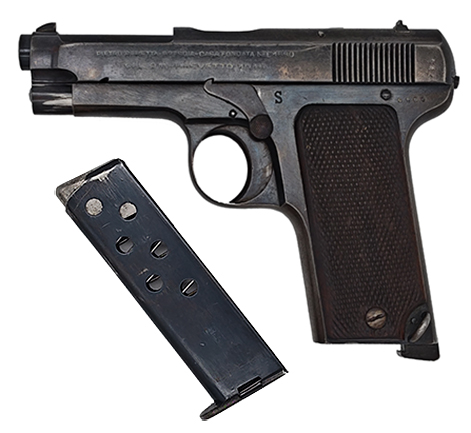
Writing on the slide: PIETRO BERETTA BRESCIA - CASA FONDATA NEL 1680 - CAL 9MM BREVETTO 1915 |
The Company could not even expect to be so approved at the time since it did not produce any military weaponry. The only way open for Beretta was that of working as sub-supplier to manufacturers of ordnance arms; in view of this Beretta began to produce parts for 6.5mm machine-guns, 9mm Glisenti sub-machine-guns, and others.At the time, as far as it concerned small arms, self-sufficiency in the Kingdom of Italy was markedly lacking only in the area of handguns. Pistols and revolvers in service were not wholly satisfactory from the point of view of quality or quantity, or sometimes of both.
We do not know to what extent the various factors mentioned influenced the decision of Pietro Beretta (1870- 1957), presumably taken between 1914 and 1915, to proceed with the design of an automatic pistol for military use. What we do know for certain is that its patent is dated 29 June 1915, a month after the war against Austria had broken out.
The calibre choice had doubtlessly been influenced by the fact that Italian Royal Army automatic pistols the M1910 and the Brixia) were in 9mm Glisenti. Moreover, Beretta had tooling equipment for manufacturing and gauging barrels in this calibre for the FIAT model 1915 submachine gun.
For actual mechanics, however, restrict ing specifications were probably less, and it was here that the professional ability and critical attitude of Tullio Marengoni, a foreman employed by Beretta, emerged.
To him goes most of the merit in the realizatdion of the Patent 1915 and many others following. |
 |
|
The picture of pistol disassembled shows the principal components |
Whereas the professional ability of Marengoni has been amply proved by various projects carried out successfully lat-er, reference to his critical approach perhaps requires clarification. No doubt, when facing the new task, Marengoni took the experience of other people into consideration. The turn of the century had seen the appearance and sudden disappearance of many weapons whose mechanics involved a large number of components, complicated tooling and, there-fore, high costs. In tact, only relatively few models survived, the larger part of which had simple mechanical solutions.Marengoni thus would have had an opportunity rightly to appreciate the principle - widely known but seldom applied - that the less the number of components of a weapon, the less will be cost, time of production and risk of breakage.
Accordingly, with an eye to simplicity, the Patent 15 came into being: a fixed barrel, blowback operation, an enclosed hammer rather than a striker, a solid frame, without the side plate which was popular at the time. In effect, the only extravagance was the very small safety catch on the rear of the frame, the reason for which is not clear. Most likely it concerned an addition specifically requested by the military. Should this have been the case, it can be presumed that at a certain point the preparation for the 15 passed from in-house initiative to open collaboration with the potential client.
In the Beretta Museum there are three 15s, one of which is supposed to be the prototype. It is without marks, serial number and rear safety catch. The most apparent difference in relation to production pistols is shown by a slightly shorter barrel which does not protrude from the slide. Other visible differences are in the shape of the slide itself, with narrows towards the muzzle, and in the trigger guard, similar to the one of a pin-fire revolver. In short, although it holds the fascination of being a prototype, it is really quite ugly.
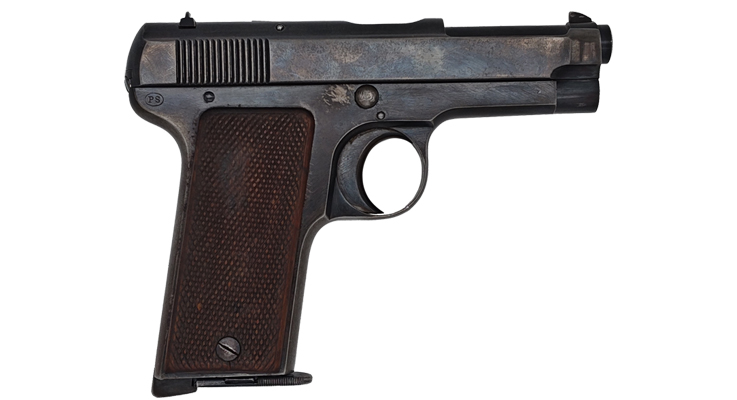
The safety system is characterised by what can reasonably be considered the original ideas of Marengoni: a safety-dis-assembly lever, blocking the trigger, and a small lever, positioned as on the Browning M1910 pistol, acting on the ham-mer. Possibly customer's wishes can be found on the pistol with serial number 3.
This weapon is a production 15 but has a different front sight and shape of the safety catch, already moved to the rear of the trame.
The layout of Marengoni's first design followed the Browning codification, which at the time was widely used, particularly through more or less authorised Spanish copies.
Some connections with the «BROWNING SYSTEM» can be found in the recoil spring organisation, in the positioning of the magazine and magazine release, and in the striker device. It is a pity that the disconnection, probably the least successful aspect of the 15, was not influenced similarly. On the other hand , the magazine is superior to the FN standard, easy to remove despite the interior release-catch, and simple to disassemble without tools.
The grip-safety, which was typical of a large part of FN products at the time, had been completely ignored, albeit without any negative consequences.
|
 |
On the subject of influences, traces of the Mauser can be found where it concerns fixing of the barrel and the shape of the slide which was open at the front and had a separate ejection port.
A striking feature of the 15 is the safe-ty-disassembly lever, placed in the middle of the frame, not found in either Browning or Mauser. Though original in form this concept had also been imported. It is worth noting that the best characteristic of Spanish automatics of that period was their cheapness. Not to be forgotten, however, is the contribution on the part of the so-called «Eibars» through an eye-catching modification of the Browning design, otherwise copied with great enthusiasm: the safety catch, activated by recoil spring, blocking the trigger and also acting as disassembly catch.
Excluding the function of the barrel lock, the description is also valid tor the 15.
There is however a considerable ditterance where the execution is concerned, the Beretta being of superb construction, whereas Spanish products generally look like having been «made by the blacksmith's apprentice while the blacksmith was out»3 In spite of - or thanks to, depending on one's point of view - having been inspired by various other makers, the end-result had its own particular character and was mechanically very sound, especially where it concerned the interacting mechanics of the trigger bar, sear plate and sear, one of the strong points of this firearm and definitely the most original Patent 15 marks a layout which was not to have any substantial alteration for about ten years and is also unmistakable from an aesthetic point of view.
|
 |
The only noteworthy variations which this pistol underwent in the course of its production concerned the magazine and the simplification of the recoil spring system.
Originally the magazine had six perforations in both side walls to permit the number of cartridges to be counted. Later this was substituted by the classical Beretta type, with an oblong aperture along the whole length, which facilitated both refilling and awareness of contents.
Another variation is in the magazine follower, which usually presented two apertures, possibly designed for the same purpose as the grooves found on the M1910 magazines: to facilitate refilling operations by lowering the follower between thumb and index finger. Normally, perforated magazines have a solid magazine follower, and those of the open kind are holed. This is not a fixed rule, but presumably the result of former mix-ups of parts that occurred in service.
In the original form, however, the open kind magazine was coupled with the perforated magazine follower.
The six holes found on the first magazine type should not raise doubts about its capacity (seven cartridges). In practice both types could fit eight rounds, even though this could be done more easily with the open kind.
The original recoil spring system consisted of tour components: a recoil spring rod, a recoil spring, a holding collar and a fixing key. This solution was very complicated with minimal advantages, if any. In effect, the only benefit might be in the dismounting procedure, where the separation and thus possible loss of parts could be avoided. On the other hand, it is not clear how someone capable of losing the spring or the spring rod, would not be able to lose both, whether attached or separated. |

|
As it happened, a good one-piece spring guide, easily constructed on the lathe, substituted the previous one, bringing also this feature in character with Beretta's style: simplicity and effectiveness.
This change may have occurred before the first contract with the Italian Royal Army. A certainty is that - according to records to date - weapon numbered 4956 is the one with the highest serial number containing the spring rod of the first type.
However, the recoil spring rod, unlike most other components of the 15, was not furnished with a serial number, so there is little certainty on the timing of this change.
With that in mind, the production of the 15 with a four-piece recoil spring system is estimated at one third of the total.
If about 5,000 represents a third, obviously about 15,000 represents the total The 15 with the highest registration number known today is numbered 15670. The succeeding M1917 (registered in the same series) with a known lower numbering, bears number 15649. Adding to the total quantity contracted by the Army (15,300 firearms) the two to three hundred pieces which are believed to have been put onto the commercial market at various intervals, one arrives at about 15,600 pieces, which represent the estimated total It seems clear that the commercial 15s for civilian use were manufactured without any particular differentiation, and were taken from standard military production lots as the need arose, thus creating gaps in the continuity of particular military lot numbers. Nor is there any record of 15s with the crowned RE (Regio Esercito, Italian Royal Army mark which already distinguished some ordnance models and would continue to do so for others to follow.
This appears also from surviving sales registers; records preceding 4 September 1916, when unit number 2866 was sold, and following 31 July 1917, when unit number 11899 was sold, are unfortunately missing.
The first civilian customer about whom documented information is available, was a certain Battagliotti («battaglia» means battle, there is a destiny in names) who purchased pistol number 2904 on 30 September 1916. The last civilian 15 with known destination was numbered 10024, which was given to Tempini (the manufacturer of the M1910) in June 1917.
Apart from the Army, the best customer of the 15 was the wellknown Milan arms merchant Ravizza, who of the total range known to have been sold - 9,033 pistols took 45, all bought during 1916 and 1917. |
 |
The oddest client was a certain «scrittore», which means «writer», who purchased pistol number 5232. The oddity lies in the fact that the initial «s» was written with a small letter which would indicate that the in-house registration referred to the client's occupation rather than to his name. Imagine such a system being used today: serial number XXZ, rogue; serial number XYZ, wheeler-dealer, and so on.
A 15 was also given, and registered as such, to Marengoni. It seems strange that the designer should follow official procedure in the acquisition of his own creation. For the record, it was unit number 9624 which was acquired by him in May 1917
It is inevitable to make a comparison at this point with the M1910 which Beretta tried to oust as the principal automatic pistol used by the Italian Royal Army. Although both pistols - the 15 and the MI910 - provided the same finished product (seven or eight cal. 9mm rounds fired semi-automatically through a 95 mm barrels there must have been a large dit-terence in their respective costs of production, not so much on account of the number of components (they each had 51) but because of the conceptual and manufacturing simplicity of the Beretta.
It may come as a surprise that the 15 had the same number of components as the M1910. However there is a difference in that the latter had complicated mechanics, somewhat reflecting its intricate appearance, just as the linear aesthetics of the 15 could be said to reflect the simplicity of its functional parts.
A close comparison shows that of the 51 parts of the Beretta, seven are simple pins, five are screws and nine are springs of the coil type. Some parts were obtained by shearing. Three components needed more work: the iron frame, the barrel and slide forged in alloy steel 15% nickel and 1% chromium).
The M1910 has three pins, removable by hand, eleven springs (five of which are flat springs) and at least a dozen parts difficult to machine.
All considered, the M1910 is of course a beautiful example of fine workmanship, but the 15 is a better example of a battle weapon and was treated as such. During its short productive lite, less than three years, it was almost exclusively made for the Italian Royal Army.
The contract for the first 5,000 was dated 11 November 1915. It was followed by two contracts for 5,000 each and one tor 300°. The latter was signed at the time of the Battle of Caporetto débacle. It is known that on that occasion human and material losses were huge.
When cataloguing that material, historiography is usually generous with figures, but not below the level of machine-guns.
We do not know, therefore, how many handguns were seized by the Austro-Hungarians. But what is certain is that many more Austrian arms in the following years passed into Italian hands, not at gunpoint but yielded as war reparations.
The date of withdrawal from service of the Model 1915 is not known. In arms lists captured by the Allies from the enemy (i.e. from us Italians) in the course of the second world war, one encounters M89 revolvers, M1910 pistols and Berettas (without further detail). No specific mention is made of the Patent 15 even though this does not exclude it since the name «Beretta pistols» can cover the whole production range. Considering the events as they developed, it is reasonable to state that the 15 did not remain in service after the second half of the thirties when Model 1934 became available in large quantities. However, the 15 remained in store awaiting an unlikely further service role.
The swan-song came in 1943, when it was offered for sale to officers at the modest price of 165 lire, equalling about 50,000 lire (about US $35) in today's money. The price of the M1910 was then 195 lire, or about 60,000 lire (US $40) of today.
At first the Beretta 15 costed 65 lire each, reduced to 62 lire in the second contract and to 60 lire in the ultimate two. They were always supplied with a spare magazine, invariably billed at 4 lire. Compared with today that would have been about 220,000 lire (US $ 150) plus 13,500 lire (US $9) for the magazine.
Generally speaking, we are adjusting prices to today's equivalent quotations for large supplies to the Government, and not to armoury prices of course.
Unlike other famous Berettas, including those largely for use by the military, there is no record of engraved, nickelled, silver or gold-plated versions. |
 |
General
specifications
Calibre/cartridge: 9mm Glisenti
Operation: blowback, semiautomatic, single action
Hammer: enclosed
Length: 170 mm
Height: 137 mm
Thickness: 29.5 mm
Weight: 850 g (with empty magazine)
Barrel length: 94 mm
Rifling: RH 6 grooves, pitch 270 mm
Front sight: blade, integral with barrel
Rear sight: V-shape,
Sighting line dovetailed to slide: 135 mm
Safeties: manual, lever, acting on trigger
Feeding: auxiliary, lever, acting on hammer
Magazine: capacity detachable box 7 cartridges
Magazine catch: in butt
Hold-open: system follower contrast on breechblock
Finishing: blued by immersion
Start of production: 1915
End of production: 1918
Quantity produced: about 15,670
Serial numbers: from l to around 15670
|
 |
Thanks Berserker Firearms for providing all the pictures publisched on this page.
https://www.berserkerfirearms.com/
Email: berserkerfirearms@gmail.com |
|
|
The copy of this page is coming from a highly informative, comprehensive study of Beretta pistols.
A book for collectors and enthusiasts.
EDITORIALE
OLIMPIA |
|
| |


