Beretta Web - Beretta Pistol 1922 .32 ACP

Beretta 92 History | Beretta 92 DeLuxe | Beretta Billenium | Beretta 90-TWO | Beretta 92 | Beretta 92S | Beretta 92SB
Beretta 93R | Beretta Target | Beretta 92 Combat | Beretta 92 .22LR Kit | Beretta 92A1 | Beretta Vertec Steel | Beretta 92 Gost
Beretta 418 | Beretta 1931-1934 | Beretta 1934 | Beretta 70 series | Beretta 90 | Beretta 950 | Beretta 9000
Beretta 80 Series | Beretta 86 | Beretta 89 | Beretta U22 | Beretta 8000 | Beretta 51 | Beretta Olympic
Beretta CX4 | Beretta PX4 | Beretta PX4 SC | Beretta RX4 | Beretta PX4 .45ACP SD |
Beretta 412 series | Beretta A300 | Beretta 1200 | Beretta Pump Guns | Beretta SO series | Beretta SO5 | Beretta UGB25
Beretta 91 | Beretta MAB series | Beretta PM12 S2 |

Beretta Web - Beretta model 1922 - 7,65 mm

Unofficial Beretta Site

...


The first Beretta Model with OPEN SLIDE

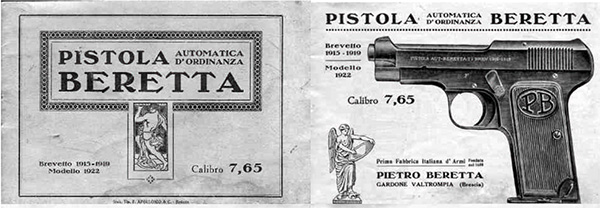
Less than a year after Patent 1919 Mod el 1920 calibre 6.35mm had been put on the market about 17,000 pistols had been manufactured by 31 December 1920) Beretta began production of Model 1922. The first pistol of this type entered Beretta's Brescia warehouse on 21 February 1921. In the official catalogues of that time the pistol was described as Model 1922. Probably, despite the fact that manufacturing had begun ten months earlier, Beretta wanted to announce that he had definitely started to market this new weapon.

In order to obtain sole rights for the new system of fixing the barrel to the frame, patent no. 172.302 of 10 February 1919 applied to Model 1922 as it had done to pistols of previous Model 6.35 mm. Also for this weapon the new type of safety catch was accepted, as was the new shape of the slide, characterised by a large opening that left open almost all of the upper surface of the slide, thus eliminating the narrow ejection port.


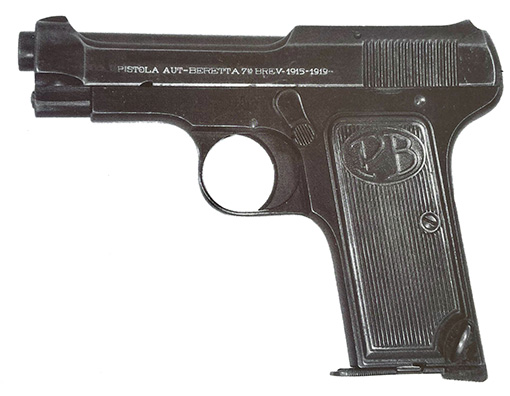
one of the first Beretta 1922


One of the very first 1917 Pistol Writing on the slide: PISTOLA AUT- BERETTA 7,65 - BREVETTO 1915-1919


To ensure sturdiness the slide was however closed in front where the sight was fitted. This solution, which was necessary for disassembling the barrel and which remained unaltered until the most recent Beretta models), had the positive characteristic of appreciably reducing the risk of jamming on account of faulty ejection of cartridge cases.
Moreover it had the advantage of being easier to make and, as a result, of being less costly.
The two modifications described above had the additional merit of getting rid of the last remnants of outside influences (Mauser) and making it a weapon incorporating original mechanical solutions.
The rear sight was made an integral part of the slide, and could therefore not be laterally adjustable as on Model 9/.
Another difference that can be noted in comparison with the latter, is the slight backward re-positioning of the safety catch because of the different system of barrel-fixing.


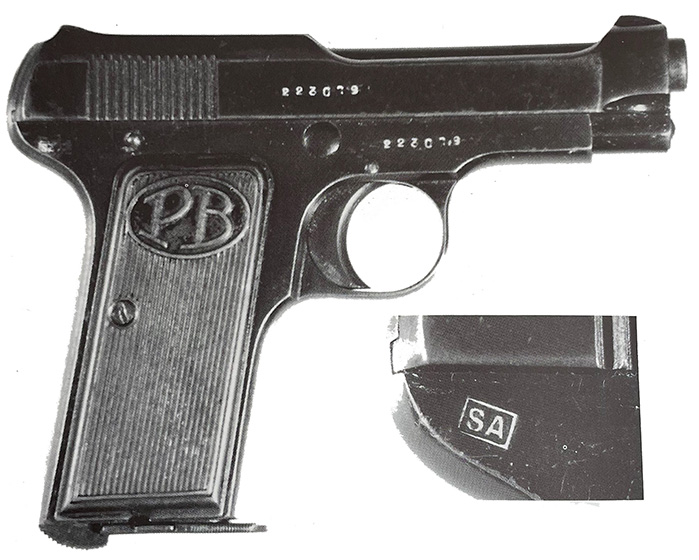
Beretta 1922 Italian Air Force


The Italian Royal Air Force, which had been established not long before - relevant decree was dated 28 March 1923 - acquired its Model 22 pistols. These can be recognised by the 1927 proof mark of Gardone, on the left side of the frame, and the mark of the military inspector
(SA) on the right

Furthermore, the somewhat smaller safety lever can now make a larger rotation arch (120° instead of 60° than was possible on Patent 1919 Model 1920 calibre 6.35 mm pistols. Also, like on the pistols of this latter model, grips were made of pressed steel with the Beretta monogram placed on the upper part.
The frame of Model 1922 is however almost identical in size to that of Model 1917. Also the magazine is interchange-able. The pieces of the firing mechanism are very similar. Marks on the slide (Brevetto 1915-1919, Patent 1915-1919 re affirm this structural relationship.

Numbering began with no.200000 and ended with 242780; the pistol so numbered was sold on 20 October 1932
In the course of its ten-year production, Model 1922 hardly underwent any modifications. The only appreciable difference was the shape of the magazine release catch, which became progressively rounded in line with the aesthetical and functional style adopted by contemporary mod-els. In addition, the designs of the rear part of the slide and the rear sight were changed. Minor differences can be noticed in the form of the grips and their screws, and in the finishing of the safety catch.

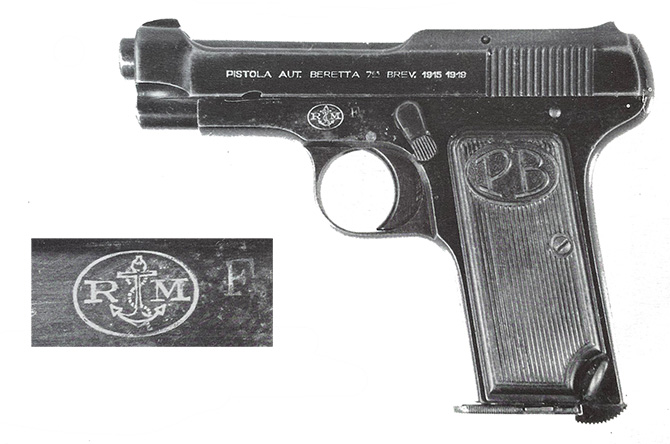
Beretta 1922 ROYAL NAVY
The Italian Royal Navy bought a several hundred Model 22 pistols, punch marking them with its symbol on both sides of the frame. Note the magazine release catch of the 2nd type, which is rounder than that of the previous type.

Although Model 1922 had not been officially accepted, a few hundred of them were sold to the Italian Royal Navy and to the Ministry of Military Aviation. This constituted the basis for the development of future Model 1931.
A limited number was used to arm the fascist Road Militia, and a few dozen were sold to various town councils.
Between 1926 and 1930 different arms, probably in engraved and gold-plat-ed versions, were bought by the Royal Household through the Scolari armory in Rome. During these very years the standard of finish of the weapons attained a level that was comparable to that of the best quality of arms produced in Europe.
The desire to make a high-quality product was also evident from the care Beretta took in the choice of outside suppliers.
Gold-plating, for example, was done by Raffigni Company of Milan. The mother of pearl grips were worked by Mazza Company in Torre del Greco (Naples).
Finally, the ornamental silver work was carried out by Calderoni Company of Milan.
All this earned Beretta the title of «Purveyor to the Royal Household, a title much coveted and difficult to obtain..

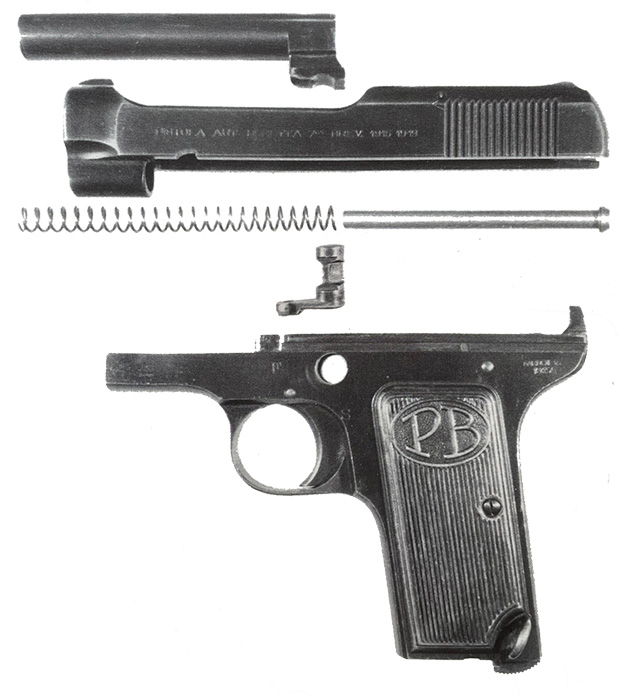
Beretta 1922 disassembled

The picture of pistol disassembled shows the principal components


General specifications


Calibre/cartridge: 7.65 mm Browning .32ACP
Operation: blowback, semiautomatic, single action
Hammer: enclosed
Length: 150 mm
Height: 110 mm
Thickness: 25 mm
Weight (empty magazine): 610 g
Barrel length: 84 mm
Rifling: RH 6 grooves, pitch 295 mm
Front sight blade: integral with slide
Rear sight: V-shape, integral with slide
Sighting line: 122 mm
Safety: manual, lever, acting on trigger
Feeding: detachable magazine
Magazine capacity: 8 cartridges
Magazine catch bottom: in butt
Hold-open system: follower contrast on breechblock
Finishing: blued by immersion
Positioning of serial number: all figures last 3 or 4 digits frame, slide; barre lug, trigger, trigger bar, magazine catch
Start of production: 1922
End of production: 1932
Quantity produced: 42,780
Serial numbers from: 200000 to 242780


banner owner manual Beretta 1922

Original digital Owner Manual it is available

<Click Here>

Editoriale Olimpia

The copy of this page is coming from a highly informative, comprehensive study of Beretta pistols.

A book for collectors and enthusiasts.

EDITORIALE OLIMPIA


Stat | Site Map | Links | Contact Us | ©2026 BERETTAWEB.com